SNV30239

SNV30239

Blogging about

I love blogging about... books
Showing posts with label glass houses. Show all posts

Sunday, 8 October 2017

A day at Sulby Gardens


A new garden to explore is always a joy isn't it? A weekend wander around a garden with cake and coffee at the end of a visit is a pleasure for so many of us.
 
To get a chance for a private visit to a garden with two friends who happen to be gardening experts, and enjoy a ramble around with the owners, is even more of a treat.
 
That's why I loved going to Sulby Gardens, to record a programme for BBC Radio Leicester's gardening programme, "Down to Earth" doing just that. Derek Cox and Josie Hutchinson , from the programme's panel of experts were with me.
 
Tucked just inside the Northamptonshire side of the border with Leicestershire, Sulby Gardens consists of twelve acres of formal gardens, kitchen gardens, orchards, a wood and even an ice house.


Alison has lived here since 1976. She and her husband Chris were fired with enthusiasm after reading John Seymour's 'The Complete Book of Self Sufficiency' and were inspired to buy a walled garden and live in the Head Gardener's Cottage there.
 
There were glasshouses and old storerooms which still bear the pencilled notes on the doors detailing how many fruits and carrots were picked in the early 1900's.


Part of the old apple store is now a conservatory where expertly trained (according to Derek) grapes festoon the ceiling.
 
 
There's a rather large glasshouse from 1904, which was the original carnation house.


 A place to sit out of the rain, looking down to part of the kitchen garden


Alison's husband Chris died nine years ago at the age of sixty. However he's left quite a legacy and they both have amassed a wonderful collection of sixty three varieties of apple trees .


There's a certain romance to the names of the old and new varieties of apples grown ...and there's also a dozen varieties of pear trees .We tasted two or three varieties as we munched our way around the kitchen garden and then found ten varieties of plum trees on the verge of ripeness.


Bill Barker has been the Garden Manager here for twenty years or so, and he too has played an important role in the development of the garden, especially since Chris's death. In fact Alison says he's an important reason why she has been able to stay here - she simply couldn't have done it on her own.

On the right hand side of the walled garden, glass houses previously abutted the walls for a couple of hundred yards or so.
.

And that's why Sulby Gardens is so interesting...because the gardens belonged to a minor stately home built in 1792 and designed by Sir John Sloane. Echoes of its gardening past are all around, but the house itself is no more. It was demolished in the early 1950's .

We winced and shuddered as we heard this - having seen photographs, it was a beautiful building. Yet we were able to admire what remained of the more formal area of gardens


It's ironic, because so many owners of old houses have, over the years, sold parcels of their estates or gardens for housing or development. Alison and Chris did the exact opposite, they managed to buy extra land to increase their garden, to build a wood and seven ponds.


 With the wood, they inherited an ice house. I was dying to see this...Josie walked over it without knowing at first!


This dates from the late eighteenth century and is listed.


 We all trooped down the stairs and inside in single file, the temperature immediately dropping as we did so. No torches, but fortunately I had my trusty iphone to light our way


This was where tons of ice, were hacked from the stream running through  the gardens by the gardeners, and thrown into the hole. Meat, game and fish, butter and other foods were kept here on the ice until needed for the table.

By now, we had spent two hours wandering around the gardens, enjoying the views and the plantings. We'd also admired the way that Alison, Chris and Bill have enhanced the gardens over the years and developed flower meadows and wildlife habitats for mammals, insects and birds.

By now, the drizzle and wind had died down and we were able to relax on a garden bench in the sunshine.

Left to right...Bill Barker, Josie Hutchinson, Derek Cox, me and Alison Lowe


Such a lovely day and such an interesting garden, with so much to see . You can hear the programme we recorded by clicking this link

http://www.bbc.co.uk/programmes/p05gydwf

You can also see the gardens for yourself as they are open on Thursday 12th October from 1 pm to 4pm and again on  Friday 13th October from 11am until 4pm...

Alison and Bill will be around, and you've got the chance to buy some bottles of fresh apple juice too, which is pressed and bottled by Bill, but only sold to garden visitors at open days for the National Garden Scheme. There's plenty of apple cakes to taste too!

Here's just three of the varieties, and Sunset, the bottle I have tasted is absolutely delicious and addictive.


Sulby is worth a visit any time of year though and opens regularly....so do check with the Northamptonshire branch of the National Garden Scheme to find out next year's dates. You will be so pleased you did!
 

Thursday, 3 March 2016

Two very different gardens in Copenhagen

It's four weeks ago today since I visited two very different gardens in the Copenhagen area.

A grey cold day at the beginning of February isn't the ideal time to see these outdoor spaces in their full glory of course, but there were compensations. You can see the bones of the garden , the hard landscaping and it's fun to imagine what they look like in the lushness of the summer months.

In the morning, Lucy and I went out to the Louisiana Museum of Modern Art which is about forty km away from Copenhagen, a mere thirty minutes by train. we were there to see the artworks for sure, but I was very interested in what the garden had to offer.

The museum is set overlooking the sea and Sweden...yet at the front entrance, it looks like what it was...a 19th century home.


 It was built in 1855 for Alexander Brun , a Master of the Royal Hunt and if you're wondering why it's called Louisiana, well, he married three women who were all named Louise. At least he never called any of them by the wrong name in the throes of passion.

But in 1958 the then owner  Knud W. Jensen opened this place as a museum of modern art. And before you even arrive at the front entrance, you can see that this is a museum which is a major player. This Henry Moore statue simply can't be ignored.


 At the back of the original house you can  still see part of the garden as it would have looked when Alexander and any of his three wives were here.


But the main house now has two modern wings where the main exhibitions are shown...all sleek white walls  and glass which bring the outdoors in, especially in the
 Giacometti gallery overlooking the lake.


And in winter the starkness of the steel grey sky and sea are offset by the sixty or so sculptures dotted around the garden by Alexander Calder...


Miro, and many others.


In some areas, though , the trees look as if they have carved out of the ground...I admired  the patterns of the roots on show


before following Lucy back towards the house, where I could imagine all the Louises sitting on the verandah looking out to sea.


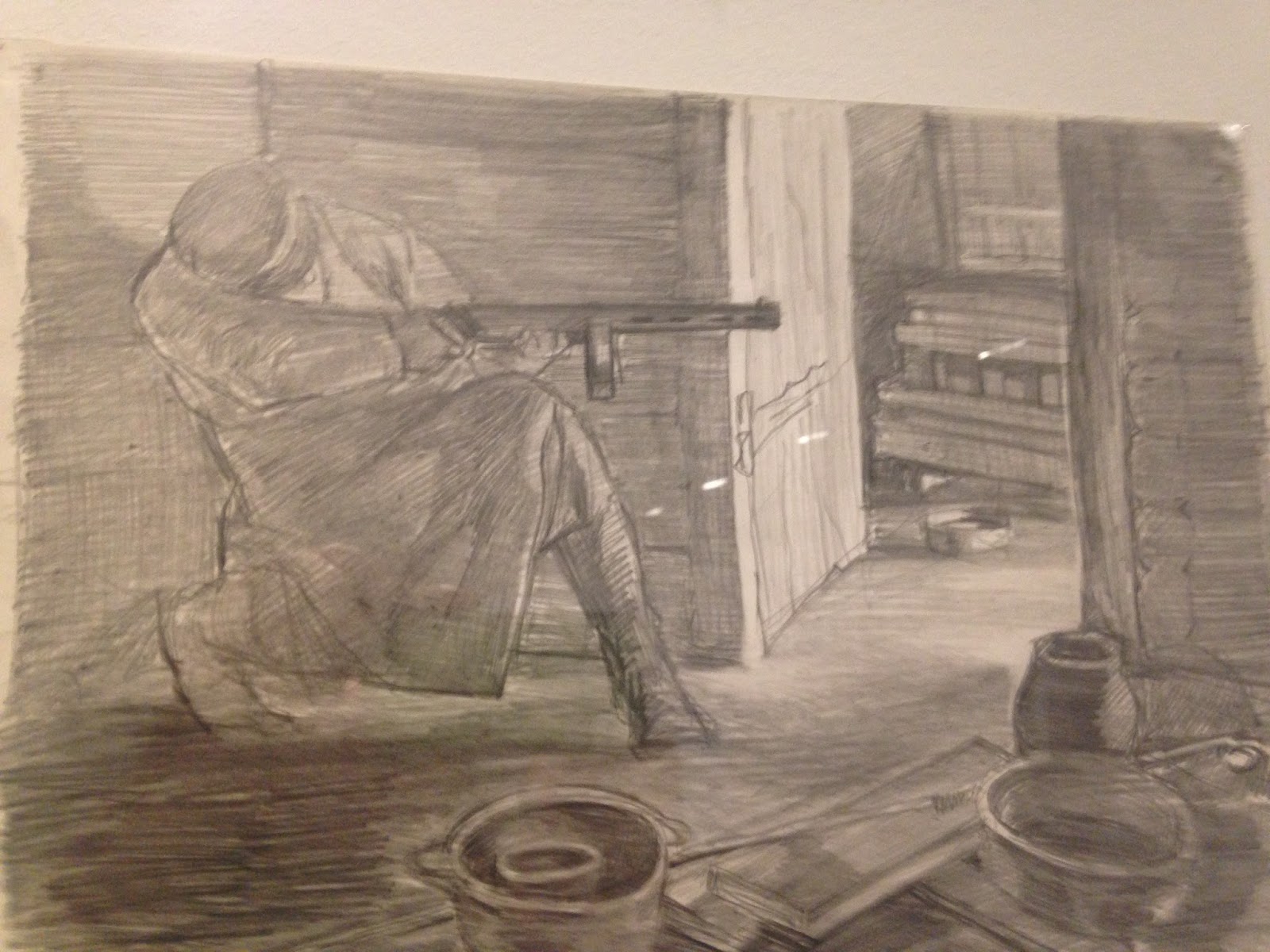
Indoors there are numerous exhibitions which are constantly refreshed, as well as 3,000 works in the permanent collection. Warhol, Lichenstein, Picasso, they're all here...but Lucy and I were intrigued and completely drawn in by Resistance, the exhibition byMindaugas Lukosaitis  


A hundred or so finely captured sketches showing the horrors of conflict, soldiers, the people  defending themselves , their homes, the bloodshed ....there's such an immediacy and vibrancy here.

And we couldn't ignore the whole wall of colour which sent us virtually cross eyed... a whole corridor of blue and red squares


by Francois Moreliet whose work is based on telephone numbers taken at random from the telephone directory.

But this is a post about gardens in Copenhagen, so onto the University of Copenhagen's Botanical Garden, which is a mere two minutes from the hubbub of central Copenhagen.

A slight mizzle by now, but it was our last afternoon in Copenhagen and I was determined not to miss it. With twenty four acres and twenty seven glasshouses, there's quite a lot to see but entrance is free and it's well worth a visit.


The stars of the show for our visit on a winter's afternoon were the glasshouses. Imposing, Victorian, I adore the ornate class of these standing proudly on the hill.


And once inside , they took us to different continents, different worlds....


And in the largest, most central palmhouse there's a beautiful cast iron staircase which you can climb, and then walk around the perimeter at the top of the glasshouse and look down on a tropical rainforest...


and then as you walk through the other glasshouses, there are progressively cooler, drier gardens .


 But as with so many botanic gardens, this is a place for serious research which was built on this site at the beginning of the 1870's. This is where the city's old fortifications were  - you can see the old ramparts where the rock gardens now.


The lake was created from where the old moat used to be....I really love how the designers worked with the space , highlighting the origins of this space, not completely obliterating them.


The Botanical Gardens are fascinating even though many the 13,0000 species planted here were hibernating for the winter. To be able to spend an hour or two wandering around admiring the views, and the planting of the glasshouses made me feel very content indeed.

What a lovely final day to our trip to Copenhagen. I can't wait until next time , and although Copenhagen is a city for all seasons, next time our visit will be in the summer!