SNV30239

SNV30239

Blogging about

I love blogging about... books

Monday, 15 March 2021

Days of sowing seed more successfully


We're in the middle of the magic month which all gardeners have been waiting for. The month of annual acts of faith and hope in the future. Yes, the yearly seed sowing jamboree is officially underway. 

Of course this year, many started their seed sowing early. Being at home in lockdown and a few days of warmth and sunshine prompted lots of early activity  and I started my first sowings in mid-February of beetroot, sweet peas and peppers.

I was so driven to sow something and I had run out of the seed compost which I trialled last year and was very impressed by. Foolishly I nipped into a local DIY and garden centre not far away and quickly bought the only seed compost I could find. Well, it was cheap and on special offer. Two small 12 litre bags I thought, would do the trick for right now.

When I opened the bag though, I was so disappointed. It was clumpy, with large strands of baler twine, hair, large twigs and goodness what else. I had to sieve it to get rid of a few stones and the other offending bits before use. 

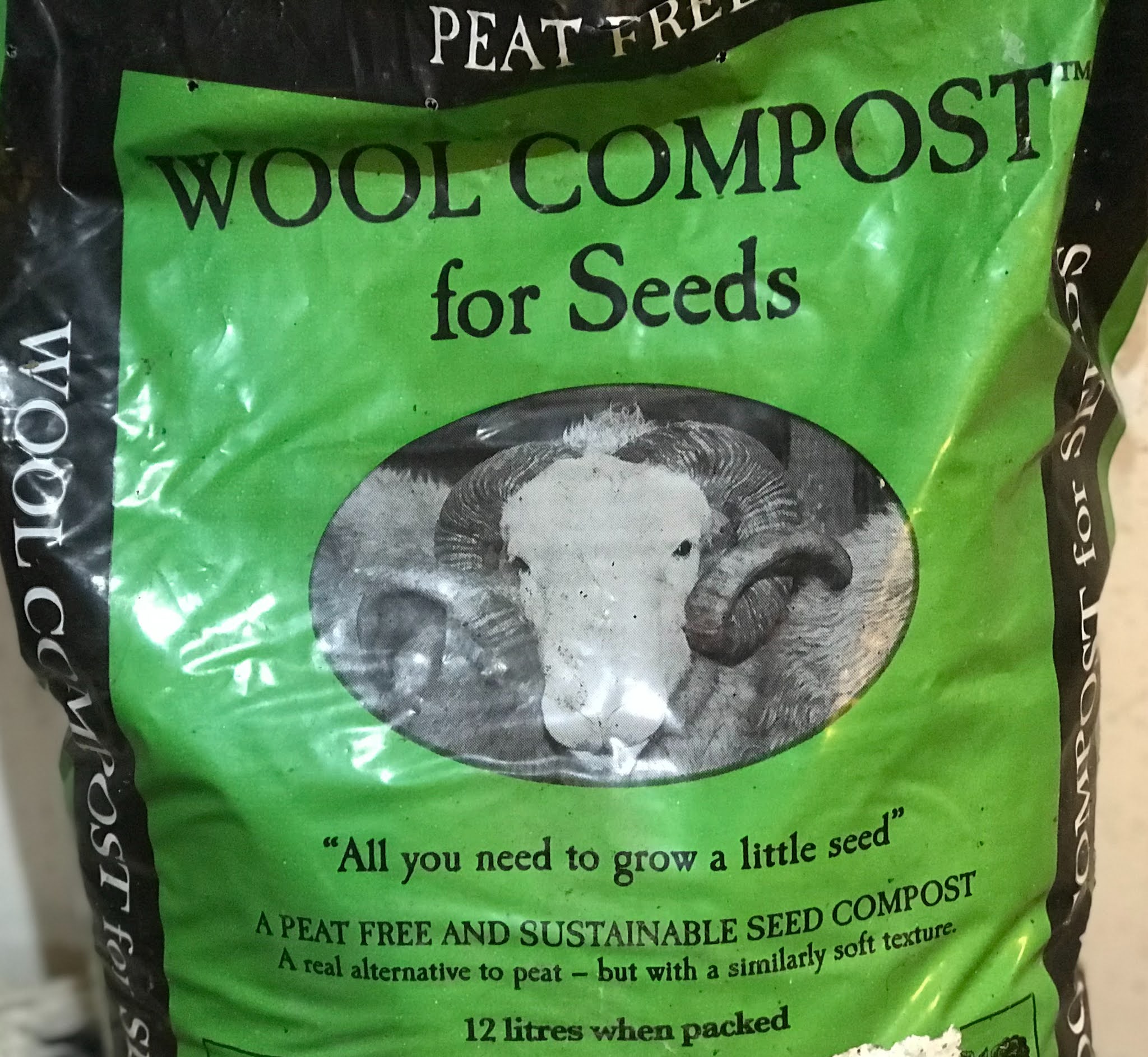
I'm not going to name what product I bought, but I've learnt my lesson when it comes to buying compost. You get what you pay for.  Dalesfoot Wool Compost for Seeds is what I trialled last year , and yes it may be  more expensive to buy, but the germination rate was virtually 100 per cent across the board.


The compost is a fine-textured mixture of wool and bracken from a farm in the Lake District, and I didn't need to water my seeds so often. I was so pleased with this, but apparently there's a new version which has just been brought out with added comfrey. Comfrey's benefits are well known, giving high levels of potassium, phosphorus and nitrogen, so I can't wait to try some and compare the two bags of peat free compost. 

I've also been paying closer attention to the way I sow my seeds and transplant the seedlings in the last year.   I've always been a "stick my finger in the compost and lob a seed into the hole " type of gardener but not now.

I'm using a dibblet. I'd never heard of one before...a dibber yes, but not a dibblet. Here it is...


This one is made of beech and made to last. It's hand turned and has graduating rings of one cm each so that you know exactly what depth to sow seeds and transplant tiny seedlings. It may be a small item, but as they say, good things come in small packages. 


So far so good, but previously I've had trouble transplanting the seedlings to bigger pots or outdoors.


I was always told that you must handle them by their leaves so that you don't damage the tender stems, when potting on. Well, that's never worked for me. My clumsy fingers ( including a couple which are slightly arthritic) always managed to crush either the stem or the leaves., or even both! 

Until I was sent these seed cell trowels that is. Last year they made potting on seedlings or removing  plants from seed trays  to plant in the ground so much easier. 


They may be tiny, but they are beautifully made, strong and good to work with. They have certainly helped prevent damage to leaves and root disruption by my clumsy handed ways. That has saved the loss of many seedlings I can tell you.

They would be ideal for house plant gardening too. Not that I have any house plants though as, like I've mentioned before, bringing a house plant into my house is like putting them on death row.

http://thinkingofthedays.blogspot.com/2011/11/days-on-death-row.html

That was a long time ago however.  As the sun has come out this afternoon, I'm going into the garden to plant these beetroot and broadbean seedlings now. Using my little seed cell trowels of course..........


Note
The dibblet costs £5.99 and seed cell trowels  (£9.99 for the pair) are all made by Burgon and Ball. I've bought so many products from them over the years, for myself and as presents for friends and family, but these were sent to me for review. 


Monday, 1 February 2021

A day of making marmalade and sleet


 In the first lockdown here in England, everyone started making sourdough bread. In the second lockdown, baking banana loaves were a craze, and in this lockdown, making marmalade seems to be THE thing.

Sourdough baking and making marmalade take time, and that is one thing many of us have during lockdown. Unless you're a parent and homeschooling that is.

I haven't made marmalade for a number of years and to be fair,  I wasn't going to this year either.  Until I went to Waitrose to buy some food and spotted a few boxes of Seville oranges at half price. Call me a cheapskate but I do like bagging a bargain.

I was going to buy two boxes but there two others behind me also wanting to a box, so selflessly I only took one box. That was a mistake ...

Snow which didn't settle and sleet came on Saturday with a biting wind. I didn't want to go out, so marmalade making was definitely on the agenda.

I rather like Pam the Jam's recipes....she's the preserves maker from River Cottage, and I've watched some of her videos on youtube. Wonderfully relaxed and quietly spoken, you know you're in safe hands with her.

First of all, I did as I was told and took what Pam Corbin calls the "little bottoms" off the Seville oranges 


before slicing them in half, juicing them and taking all the pips and pith out of all them.


Then came the rather long-winded business of cutting the rind into very thin slices, but it's the sort of activity that seemed just right for a quiet sleety Saturday especially whilst enjoying listening to the radio or a playlist. I chose a catch up on BBC sounds listening to the final instalments of the wonderful serialisation of "The Snow and the Works on the Northern Line " by Ruth Thomas, which I really enjoyed. A story of an accident, heartbreak, and ultimately revenge.

The pips and pith were wrapped up and tied tight  in a piece of muslin and popped into the pan along with the juice and some water, 


and simmered away for about ninety minutes. The glorious scent of oranges filled the whole kitchen in a warm, aromatic hug and brought back memories of various trips to Spain. Not that I spent my holidays making marmalade you understand. I was remembering my first ever visit to Spain, that was Sitges when I was ten. The first time I ever saw oranges growing on the trees near our hotel in Soller was two years later and the last time I went to Spain was a  couple of years ago. We were staying near the orange groves at a friends villa by a golf course near Torrevieja. 

It was time to add the sugar, The lovely Pam used golden granulated, but I went off piste and used a  mixture of granulated and demerara sugar, which worked well.

I must admit I started panicking when, despite achieving a lovely thunderous boiling roll for well over ten to fifteen minutes, my marmalade still hadn't reached setting point. Another ten minutes passed, but my friend Josephine advised patience on our whatsapp group. "It will set." So, I poured the marmalade into the jars and even after a couple of hours, I wasn't hopeful. 


Patience is a virtue, and the following morning , there were jars of perfectly set marmalade. Delicous marmalade which such a depth of flavour I've not tasted for quite a long time - since I last made marmalade in fact. Smothered on my seeded sourdough bread, with a strong hit of coffee, it's a  wonderful way to start my mornings.


It was far cheaper to make than buy too, so next January, I know what will be on the top my to-do list. 
Making marmalade again! More of it though, as I shall be buying at least three boxes of Seville oranges next time.

You can follow Pam's recipe on the River Cottage youtube channel  here...

https://www.youtube.com/watch?v=au3UEXpfFNA

Meanwhile, on my book wish list is The Book of Preserves by Pam the Jam, published in 2019 by Bloomsbury. I shall be needing it later in the year for all the fruit I'm growing organically on my allotment.

Tuesday, 26 January 2021

4 snowy days in lockdown 3


How our world changes when it becomes winter white .
There were flurries of snow as we walked the dogs across the fields on Saturday morning, followed by sleet which washed away the slight, snowy traces. 

On Sunday morning, this was the scene from the dining room  - about three inches of snow enveloping the garden in icy white clothing.  


My husband walked the dogs early that morning which was just as well, By the time he got back stamping his feet and drying the dogs' paws,  snow was falling and settling. It continued for about five hours, until  at last there was a lull. The skies were grey and heavy, it was still freezing, but I had to get out for a short walk before dusk fell.

Looking like the Michelin man, bundled in layer upon layer, I began a short walk around the village, the dogs padding silently beside me, as we walked along our lane...


I was tempted to go into the field opposite, but it was already after four o'clock, so I decided to turn left and take the main road through our conservation village. The lane I live on has three thatched properties, a few cottages a church, an old chapel and what were two farms, very much the working part of the village. The main road through is filled with grander properties at this end, and as the road twists, the beautiful trees always catch my eye whatever the season.


I thought I was alone in this eerie winter scene until I caught a glimpse of a friend and his dog Betty. I was immediately aware how timeless this scene is...we could have been meeting in the 19th century as the sweep of the road hasn't changed for years. 


David and I stood and chattered, but Boo and Eric were getting cold standing in the snow, so I took the cut through to the church...


I love the sight of our small village church come rain or shine, but in winter, it looks breathtaking,


The light was fading in this monochrome world as we made our way through the churchyard, heading for home.


So, an invigorating walk, but the warmth of the kitchen when I arrived home was wonderful, especially as the snow began to fall outside again within minutes.

Yesterday though, there was a completely different feel to my afternoon walk. More snow still lying on the ground but with blue skies and sunshine for most of the day. Others walking around the village, quick chats as everyone tried to keep their footing on the ice which lay underneath the snow. It was lovely to hear the excited chatter of children playing outside,  with few cars still, in our small village on top of a hill, 170 metres above sea level.


As I walked down the hill to the next village, I admired the stark beauty of the fields beyond.


On the way back I passed the sheep who thought the dogs and I had come to feed them.  We hadn't, so they lost interest but kept close as I took this shot of them and the sun which was beginning to set.....


Today is our fourth day of snow, the roads are treacherous around here, so we're not leaving the village yet.
The cupboards are full of food, luckily there is no urgency to get out and I think how precious these slow snow days are.

Meanwhile, our garden sleeps until the rain, which is forecast for later, arrives. 


Then it's back to whatever normality is in this lockdown life.......


Saturday, 23 January 2021

Eating local - the Fife diet day 3

So, it's the third day of my challenge...and already it's very interesting.


On day one, I started off with boiled eggs and soldiers.The free range eggs were from a friend's farm about  four miles away, and the bread was from Jessica, a local artisan baker who uses flour milled in Leicestershire. So a good start to the day....

For supper, I took out of the freezer a pasta sauce I made in the autumn using my homegrown tomatoes
(you can read the recipe on my other blog at www. thinkingofthedays.blogspot.com).


Now usually I would of course accompany this with some dried pasta, but that 's not an option now  so I had a jacket potato and some of  last year's homegrown peas which were also in the freezer. Unfortunately there's not many of those left so I'm going to have to start sowing peas earlier this year!


I completely forgot  to preplan what I would have for lunch though. Luckily, a hunk of the same bread  and some excellent Sparkenhoe Red Leicester cheese ( made in Market Bosworth and made from unpasteurised milk from their farm) did the trick.

So day one of the challenge was successful...at least eighty per cent of what I ate was  grown or made locally. I did have two cups of coffee though and there was a  third of a cup of red wine in the pasta sauce.Oh and I drank alot of tap water....

I was more prepared yesterday --and  luckily as it was the first Thursday of the month..I popped down to the Farmers Market in Market Harborough.


I couldn't resist some Gloucester old spot sausages from March House farm in Great Dalby. Boy, did they hit the spot last night with mashed potatoes...and a lovely crisp  January King cabbage, which I steamed and drizzled with a tablespoon of balsamic vinegar on top.

And yes I know, the balsamic vinegar isn't from Leicestershire....but that's why I 'm trying the eighty per cent local  food challenge and not a one hundred per cent one! Day two a success and I felt I simply had to celebrate with a glass of merlot...from France.

Cheers  my dears! But don't worry -this  isn't going to be a day in, day out diary of exactly what I've eaten.. Coming up will be reasons why we should all be eating more local food....and  I'll be telling you about a remarkable man from Fife who 's inspired thousands of people to really think about local food challenges.

Tuesday, 15 December 2020

Days of change and leaving the BBC


I've been feeling slightly discombobulated for the past few weeks.


I'm on annual leave, yet I'm not on holiday. I'm not relaxing in the sun or even having a few days away here in the UK.


Also, when I finish my annual leave, I won't be going back to work. I will officially leave the BBC on 2nd January, but I've already had my last day in the newsroom.


After twenty years of working at the BBC as a journalist, it seems strange but exciting.

I joined BBC Radio Leicester as a freelancer for two weeks initially but never left. Before then, I had worked on a cruise ship sailing around the world for a year, been to university, worked in PR, and worked at the BBC in Bristol as a reference librarian. 


I've loved it all, but being a journalist in the newsroom in a busy local radio station has been great. I’ve always been nosy you see, which drove my mother mad when I was a child. I was always asking questions. I've never stopped, and being able to find great stories and contacts and being paid for it has been amazing. 


It’s been a memorable twenty years in many ways. Although I’ve been based in Leicestershire, I’ve also travelled to Belgium, Ukraine and the Gambia working on stories I will never forget.


I've also made features for Radio 4, for 'Word of Mouth' and 'You and Yours', and occasionally for 6 Music back in the day, and my work has been featured on Pick of the Week quite a few times over the years.


Being a journalist in local radio is so rewarding, because you meet people at extraordinary times in their lives, as they share a special achievement, a harrowing story that needs to be told, or a wrong which needs to be righted. It's a privilege to help them tell their story, even though I've sobbed my socks off at times.


I've loved finding stories that no one else had, and I always say that everyone has a story, and it's often not a story you expect.


Of course, as a journalist, you also get to do things that you wouldn't necessarily expect to do. Such as driving a World War II tank,


Do have a listen... I nearly lost control of the tank at one stage.....


https://www.youtube.com/watch?v=rtdf-7Bkvg0


I've also flown in an air ambulance helicopter and interviewed some of my favourite celebrities. Each day has been different and surprising, one day being sent to interview a team of Olympic sportsmen, the next going into a prison to interview people who've been locked up for a long time, or another day being spattered with paint whilst reporting live at the Hindu festival of Holi...


I've also enjoyed presenting gardening and history programmes on numerous occasions. One of my favourites has been BBC Radio Leicester's Down to Earth, very much like Gardeners' Question Time on Radio 4. I loved careering around Leicestershire and Rutland chairing recordings with a much-loved panel of gardening experts.


I was also lucky enough to be a part of the biggest historical story of this century. Obviously, I didn't dig up Richard III personally, but I got to know the team who did, very well! The memories of reporting on and having a grandstand view of the finding of The King in a Leicester car park and his subsequent burial in Leicester Cathedral will always stay with me.


I've enjoyed working with so many talented people at BBC Radio Leicester too. The laughs, the larks, the banter with colleagues and friends who I know I will miss, but shall still see socially when we are allowed. I've so many happy, funny and brilliant memories of my mad, marvellous work family.


Still, I'm looking forward to some new adventures as a freelancer. I shall continue giving talks, there's talk of a few lectures and voice-overs, and I'm going to continue to blog, and to write and to travel. Who knows what I'll get up to?


There will be more time for gardening though, both at home and on my allotment. Most of all, there will be lots of time spent having fun with my three gorgeous grandchildren. Jasper, Clementine and Raffy have all been born during the last twenty months. 


I can't wait, but in the meantime, goodbye to the BBC. I've adored being part of such a brilliant broadcasting corporation ....the best in the world. 


. 


Saturday, 21 November 2020

Foodie Friday - the fishmonger, buying more British fish and a fish dish..

I'd never been a fan of fish, except battered fish from the chip shop.

There, I've said it. Call me what you will, but I just didn't like it. I suppose being allergic to shellfish put me off all kinds of fish, except a piece of cod,  haddock or salmon.. You know where you are with them.

Until this year that is. 

As the covid pandemic spread and the lockdown began, most of us only left our small village to buy food or fetch medicines. 

During the first lockdown, I was cooking lots of different recipes and decided I would try cooking with fish more. A fishmonger visits the neighbouring village every Tuesday afternoon so I wondered whether he would drive a mile up the hill to our village if there was enough demand.

Paul Farrell, or Paul the Fish as a few of us call him, said yes, he would come once to see if it would be worth it. So, was it? Let's just put it this way, like Julius Caesar, he came, he saw, he conquered.

It was a sunny Tuesday lunchtime, and as he arrived by the church gates,  there were about fifteen people waiting for him in a socially distanced queue. It was very convivial as we all saw people we hadn't seen for weeks, and everyone eagerly bought fish as if it were going out of fashion.


Paul has been coming to our village ever since, and do you know what? I'm really enjoying trying different types of fish.

His immaculately clean refrigerated vehicle always has a good selection of fresh fish and shellfish. Haddock....plain, smoked yellow and plain smoked, cod, plaice, hake, halibut, salmon, dressed crab, prawns, mussels, crevettes, lemon sole, Dover sole, trout and if you want lobster, he will order it in for you.


These days he visits each house individually and has built up a devoted following here. 

Paul lives in Grimsby but can be seen whizzing around the villages in Leicestershire, and at the market in Market Harborough.  


He's busy and works long hours, but he's thankful. This year hasn't been kind to the fishing industry in this country. In March,  the beginning of the first lockdown, he wondered whether his business would survive. 

Why we should eat more fish

Now in November, fishermen are in dire straights again during this second wave of Covid. So much so that we are all being urged to buy more fish from our local fishmongers or to buy direct from many fishermen who are now selling their fish directly online to customers' homes all over the country. Spread Christmas cheer, buy more fish this year.....or even send fish this year..
So I'm doing just that and enjoying many new recipes along the way.

A favourite though is Arbroath smokies or smoked haddock gratin, whatever you like to call it. This is a fairly vague recipe which was dictated to me via a friend of mine, but it's delicious...

Ingredients

large onion, finely sliced or died
large glass of white wine
6 rashers of bacon, cuts into strips
250gms of cheddar cheese, grated 
450 gms smoked haddock, cut into small pieces
half a stock cube - (fish, or vegetable,I use Swiss bouillon powder)
300 mls of water 
300mls of double cream

How to make it

Chop the onion and bacon.

Heat a few glugs of olive oil in a saucepan, and then brown the onion and bacon.

When browned, add the wine and the stock you have made with the stock cube and water.

Reduce by about a half, then add the cream. As soon as it starts to boil turn the heat down. Add the grated cheese
 
Add the cubed haddock and cook gently for about 6 minutes, then transfer to an oven dish.

Top with some more grated cheese and some chopped parsley.

Finally, brown under a preheated grill until the cheese bubbles. Or, like I do, put into the oven and bake for another 5 - 10 minutes before serving.

This is a very forgiving dish, and it will stay in the oven on a very low light quite happily for a while.  This week, I added mushrooms to brown at the same time as the onion and bacon, for a change, which worked well.

This serves four people and I usually serve this with some new potatoes either boiled or roasted, asparagus, tenderstem or purple sprouting broccoli, peas or french beans - whichever is in season.

Or for real comfort food on a cold, wintery night, you could just dunk a couple of hunks of good bread or toast in this tasty, cheesy, fishy dish and spoon up the rest of the sauce. It's filling.



Monday, 2 November 2020

Days of honesty : why you should always grow honesty in your garden

One of the most valued plants in my garden is honesty.
The first plants arrived one spring when my children were small, a couple of years after we moved to this country cottage. They must have come on the wind,and I only really noticed them when their purple flowers appeared. At first there was a couple of plants under the now departed euclalyptus tree, before spreading into the borders,the vegetable patch,the ha ha - it has self seeded at will where it pleases, even in front of the piggery door this year.
I don't care because I enjoy seeing it flower in spring ,and in the summer when the seed pods first begin to appear. Then, I adore that time in the autumn when the seed pods,looking like silver pennies, reach what I call their show off stage, and I bring a few into to brighten up the house in small vases. This year though, one huge plant was blown over showing it roots after a summer storm. Even so, I had plans for this plant, deciding that yes, it would still get its moment of annual glory. I brought it inside,and shoved it in the biggest vase I have,to dry.
Slowly, slowly the papery seed pods turned a lighter colour, some seeds fell , I saved some for my Mum's garden and the scattered more outside in mine.
But what to do with the hundreds of translucent seed membranes and all the rest of the seeds? I decided to keep them with the rest of the plant in the vases - and I'm fascinated by them.
I also love the way that honesty transforms itself by the light. Golden, when the candles are lit as dusk falls and how ghostly it becomes by moonlight. No wonder its Latin name is lunaria. In the morning though,I'm entranced when the sunshine catches the honesty,throwing a sometimes white, sometimes silver luminessence around the room. It's not surprising then, why honesty is one of my favourite plants, and this year,here in the dining room, its moments of glory will last far longer than usual.